
Calling Tree
Calling Tree (performance)
This performance is documented through video and photography.
Video
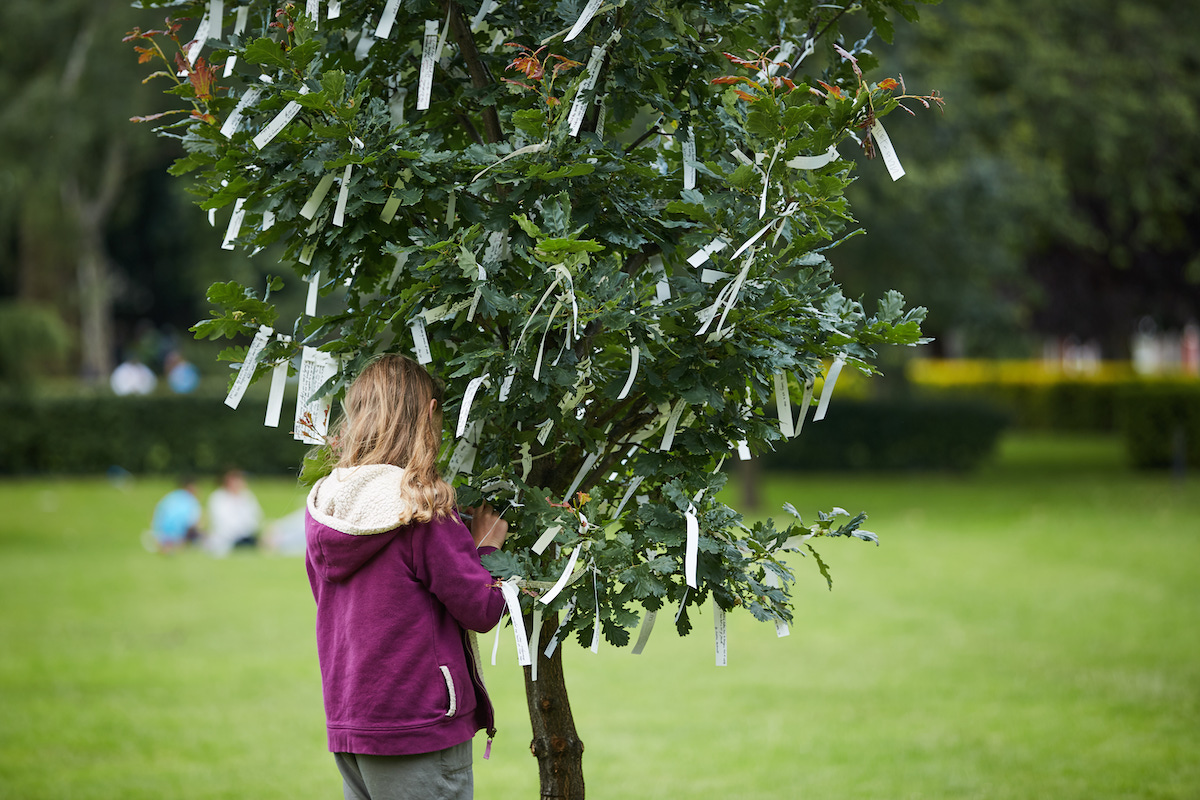
The video documentation is of two iterations of Calling Tree in London: Tottenham (2016) and then Bloomsbury (2016). The video does not document any of the additional activities or include the audience. Images of participatory events in Tottenham plus images of audience reaction in Betws y Coed, North Wales and Bloomsbury are in the photo gallery below.
Photography




Summary Statement (300 words)
Calling Tree is an iterative, durational performance work, uniquely sited in and around significant urban trees. Co-conceived by artistic directors Rosemary Lee and Simon Whitehead it is realised through collaboration with riggers, performers, and naturalists and is responsive to the local communities: human and non-human.
The core performance component uses repeating 2 to 4 hour long performance scores. Additionally activities that respond to the geographic and socio-political landscape of each site have included working with local school children, walks with naturalists, participatory dance events under the trees, curated night time gatherings – Beneath the Boughs – with emerging and established poets and musicians.
Calling Tree is practiced as a human installation – humans dwelling in trees – and invites the unsuspecting passer-by and spectator to sense their belonging to, interrelationship with, and co-dependency on the ecological system around them.
Research Aims:
- Develop an adaptive, devising and performance practice created in situ, which can change and respond to each new tree, locality, and community, whilst retaining its recognisable identity as Calling Tree.
- Create a collaborative, transformative, durational, arboreal performance that challenges the conventions of choreographing and performing at height.
- Construct a sonic landscape that experiments with combinations and layering of text, natural and produced sounds to engage and stimulates the viewers’ ecological awareness.
Calling Tree builds on and develops key concerns in Lee’s work as seen in Square Dances,1 and Under the Vaulted Sky,2 notably to reach and engage with local audiences and communities through unusual, performance events in green urban settings. Whereas these previous works subtly and non-verbally highlighted our relationship to nature, in Calling Tree Lee experimented with a more outspoken approach (speaking to other artistic practices, for example Bobby Baker’s Pull Yourself Together3) in drawing attention to our vital and precious dependency on the natural world.
References:
- Lee, Rosemary (2011). Square Dances. London: Dance Umbrella [performance].
- Lee, Rosemary (2014). Under the Vaulted Sky. Milton Keynes: IF Milton Keynes [performance].
- Baker, Bobby (2000). Pull Yourself Together. London: Mental Health Foundation [“act”].
Contextual Information
Role of Rosemary Lee as co-creator of Calling Tree:
Calling Tree is co-conceived, co-created and co-directed by Lee and Wales based movement-artist Simon Whitehead, as such they are co- authors of the work. In Tottenham and Bloomsbury they developed and directed the work together. Due to Lee’s proximity to the sites she undertook more extensive research of the site and the communities around it, finding performers and leaders for the additional curated events, such as Beneath the Boughs and she also worked with local children, poets and an ecologist, reaching approximately 150 children in Tottenham and 60 in Bloomsbury. She undertook more organizational project management.
For future commissions they will research and identify the site together to create the overarching structure and concept of the work in response to the new context. One of them will then develop the work alone, as in the small-scale version presented in Pamplona, Spain as part of the DNA Festival 12-13 May 2018 directed by Simon Whitehead after initial research visits together.
Production Credits:
- Co-created and directed by Rosemary Lee and Simon Whitehead
- Choreography in collaboration with the performers
- In Betws y Coed:
- Performers: Gisele Edwards, Alex Harvey, Sianed Jones, and Ben Stammers
- Music composed by: Barnaby Stone, Isaac Lee-Kronick and Ceri Matthews
- Vocal coach: Sianed Jones
- Rigger: Joe White
- Co-produced by Migrations and Artsadmin
- In Tottenham:
- Performers: Gisele Edwards, Milton Lopes, Alesandra Seutin, and Ben Stammers
- Music composed by: Barnaby Stone, Isaac Lee-Kronick and Terry Mann
- Vocal coach: Sianed Jones
- Choir: Susan Araromi, Abena Dankwa, Dominique Florent-Lee, Rebecca Gyasi, Divine Linde, Sheena Marfe
- Riggers: Joe White and David Bernstein
- Walks and talks by: Ornithologist David Cotteridge, Urban ecologist and storyteller Bob Gilbert
- Traditional dances led by: Kerry Fletcher
- Beneath the Boughs: curated by Rosemary Lee with Simon Whitehead
- Performers: Abraham Gibson, Kerry Fletcher with Chris Walshaw, Deanna Rodger, Jess Hardie, Sianed Jones, Isaac Lee-Kronick, Sam Lee, Jenny Minton, Helen Chadwick & Rebecca Thorn, Phil Minton, and the choir
- Co-produced by LIFT and Artsadmin, presented in association with The Place
- In Bloomsbury:
- Performers: Gisele Edwards, Sianed Jones, Isaac Lee-Kronick, Milton Lopes and Ben Stammers
- Guest performers: Grace Bowen, Claire Hackson, Maroula Iliopoula, Despoina Patsika, Daniel Persson, Marcell Proske, Erena Reilent and Katarzyna Witek
- Music composed by: Barnaby Stone, Isaac Lee-Kronick and Terry Mann
- Riggers: Joe White and David Bernstein
- Walk and Talk with: Urban ecologist and story teller Bob Gilbert
- Traditional line dances with: Kerry Fletcher
- Beneath the Boughs curated by Rosemary Lee with Simon Whitehead
- Performers: Kerry Fletcher with Chris Walshaw, Abraham Gibson, Kay Grant, Remi Graves, Sianed Jones, Gisele Edwards, and Isaac Lee-Kronick, Dessislava Stefanova, Francesca Weekes, Amy Wolestenholme and members of the London Youth Folk Ensemble. (Aaron Cuthbertson, Elve Cuthbertson, Alice Duncan, Alice Beadle, Juliet Beadle, Noah Wolton and Alex Duncalf. Tutor Esbjorn Wettermark)
- Co-produced by The Place and Artsadmin, presented in association with Bloomsbury Festival
- In Pamplona:
- Performers: Gisele Edwards, Ben Stammers
- Music composed by: Barnaby Stone, Isaac Lee-Kronick,
- Rigger: David Bernstein
Commissions and funding:
Betws y Coed, North Wales:
Commissioned by Migrations and supported by the Jerwood Choreographic Research Project, with funds from The Jerwood Charitable Foundation, Akademi, Birmingham Repertory Theatre, Dance Initiative Greater Manchester, DanceEast, DanceXchange, Fierce Festival, Greenwich+Docklands International Festival, Independent Dance, Royal Shakespeare Company and South East Dance. Additional support from public funding from the National Lottery through Arts Council England and Made at The Place.
Tottenham and Bloomsbury, London:
Imagine 2020 (2.0) and Create to Connect projects, supported by the Culture Programme of the European Union. Supported with public funding from the National Lottery through Arts Council England. Additional support from the Adobe Foundation Fund and the London Boroughs of Haringey and Camden
Pamplona, Spain:
Commissioned and funded by DNA Festival, Pamplona, Spain
Performances:
- 23 – 25 August 2014 Migrations Festival, Cae Lan Betwys y Coed, Wales. Length: 6 hours daily
- 30 June – 2 July 2016 LIFT Festival, Bruce Castle Park, Tottenham, London. Length: 4 hours daily
- 21 – 23 October 2016 Bloomsbury Festival, St Georges Gardens, Bloomsbury London.
Length: 2 hours repeated twice daily - 12 – 13 May 2018 DNA Festival, Pamplona, Spain. Length: short interventions 3 times a day
Samples of audience feedback:
A sample of feedback from audience members from emails, and recorded interviews, revealing the affect of Calling Tree on their senses, thoughts and perceptions of the wider environment.
Related publications and presentations:
1. Lee, R. (2018) Preferring the Blur: Connections between Choreographer, Audience and Tree in Calling Tree. In Ellis, Waelde & Blades (Eds.), A World of Muscle, Bone and Organs: Research and Scholarship in Dance (pp.185 -213). C-DaRE.
This chapter explores Lee’s relationship to the local people she encountered whilst working on Calling Tree in Tottenham, reflecting Lee’s research into working responsively in situ to human and non human local communities.
2. Welton, M. (2018) Making Sense of Air. Choreography and Climate in Calling Tree. Performance Research, 23:3, pp.80-90.
This chapter reveals how the author experienced Calling Tree in Bloomsbury and how it affected his attentiveness to the wider environment. Welton speaks of the work’s relationship to ecological and climatic concerns of our time.
3. Rosemary Lee’s contribution to PhD candidate Cathy Washbrooke’s presentation, The Dance of Animacy in Lee and Whitehead’s Calling Tree (2016) presented at: Dance Fields: staking a Claim for Dance Studies, Roehampton University April 2017; and Dance and Somatic Practices Conference 2017: Moving the Sensate: Questions of Affect and Embodiment for the 21st Century.
This writing reveals Lee’s relationships and responses to the environment around her, the questions she asked herself and the challenges she faced in the research. It particularly speaks of the interconnectedness she sought to find ways of encouraging the audience to feel.
Score:
Lee’s 4 hour score for Calling Tree Tottenham (opens in new browser tab)
Project website:
artsadmin.co.uk/project/calling-tree/
Note:
The team were in residence on site daily for two to three weeks before the performances following a year of regular visits and research.
Image credit:
Header image: Calling Tree. Rosemary Lee and Simon Whitehead: Tottenham. Photograph Oliver Rudkin (2016)